
Many drivers ask this question today. An EV charging station 220V offers a common solution for home charging. However, compatibility varies across different electric vehicles. An EV charging station 220V uses AC power for charging. This voltage suits many global regions. Yet, each car model has unique charging requirements. An Electric Vehicle charging station 220V typically delivers Level 2 charging. Therefore, understanding your car’s inlet type matters greatly.
Understanding EV charging station 220V Basics
First, an EV charger station 220V connects via specific plug standards. For instance, Type 1 dominates in North America. Conversely, Type 2 prevails in Europe. Additionally, GB/T serves the Chinese market. Moreover, NACS emerges as a new standard for several brands. Consequently, an Electric Vehicle charging station 220V must match your car’s port. Without the correct plug, charging becomes impossible. Nevertheless, adapters exist for some models. But using them may reduce charging speed. Thus, check compatibility before purchasing an EV charging station 220V.
AC Charger Applications and Power Levels
Aegen, a leading manufacturer, produces versatile AC chargers. These units suit garages, residential parking lots, and corporate areas. Specifically, they enable overnight or long-duration charging. Aegen offers dual-gun and single-gun connectors. Power options include 7kW, 11kW, and 22kW. For example, a 7kW EV charging station 220V works well for daily commutes. Meanwhile, an 11kW Electric Vehicle charging station 220V cuts charging time by nearly half. Finally, a 22kW EV charger station 220V delivers the fastest AC home charging. Still, not every car accepts 22kW. Many onboard chargers limit input to 7kW or 11kW. Therefore, higher power does not always mean faster charging for your specific car.
Wall-Mounted and Portable Solutions
Additionally, Aegen provides wall-mounted home chargers. These units come in 7kW, 11kW, and 22kW versions. They require professional installation. Charging time remains longer than DC fast chargers. But for home use, this proves sufficient and cost-effective. Furthermore, Aegen produces portable EV chargers. These lightweight devices offer 3.5kW, 7kW, or 11kW. Accordingly, you can keep one in your trunk. Then, plug into any available 220V outlet. Nevertheless, portable units charge slower than wall-mounted ones. Still, they provide excellent flexibility for travel or emergencies.
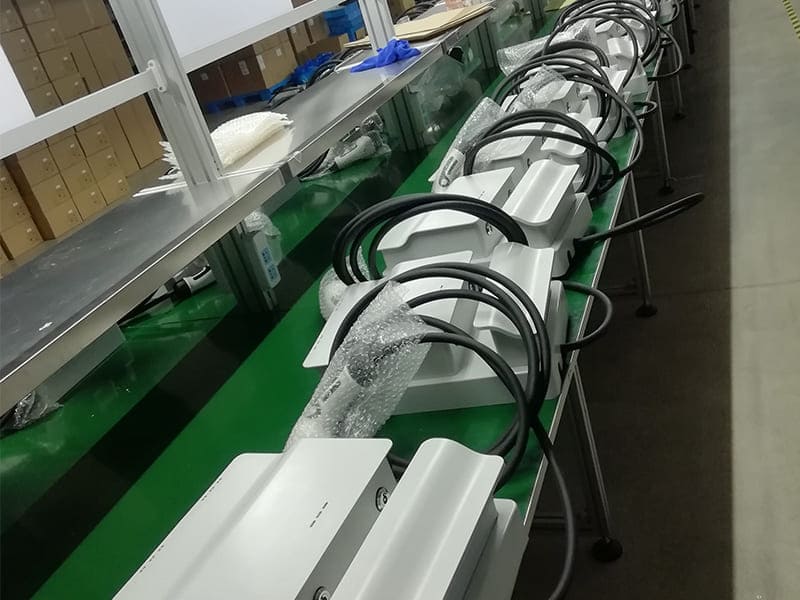
Regional Voltage Customization
Importantly, voltage standards differ by country. For instance, Europe uses 230V single-phase or 400V three-phase. North America relies on 240V split-phase. Japan operates on 200V. Therefore, Aegen customizes each EV charging station 220V to local requirements. You simply specify your regional voltage. Then, Aegen adjusts the internal components. This ensures safe and efficient operation. Without such customization, a charger may fail or damage your car. So always request country-specific tuning. Aegen offers this service free with every order.
Aegen’s Collaboration and Global Reach
Aegen works closely with multiple partners. These include EV charger distributors, charging station assemblers, and installation firms. Consequently, Aegen’s products reach Central Asia, the Middle East, Europe, and South America. Many customers have deployed Aegen’s Electric Vehicle charging station 220V units. Feedback remains highly positive. Users praise reliability and ease of use. Additionally, Aegen provides free technical support. They also offer bespoke customization services. For example, you can request specific cable lengths, color finishes, or payment system integration. Thus, Aegen adapts to diverse business needs.
Production and Delivery Timeline
Typically, Aegen completes orders within 7 to 22 working days. However, this depends on current production schedules. Rush orders may require special negotiation. Conversely, large bulk orders might take slightly longer. Nonetheless, Aegen communicates transparently about lead times. For urgent projects, they prioritize accordingly. Remember, each EV charging station 220V undergoes rigorous testing before shipping. So quality never suffers for speed. Why partner with Aegen for your EV charging station for Condos needs?
Conclusion: Does a 220V station work with all EVs?
Finally, return to the original question. An Electric Vehicle charging station 220V cannot work with every electric car automatically. Compatibility depends on plug type, onboard charger limits, and regional voltage. For instance, a Tesla with NACS needs an adapter for Type 2. Similarly, a Nissan Leaf with CHAdeMO cannot use a standard Type 2 AC charger. Nevertheless, most modern EVs support some form of 220V AC charging. You just need the correct connector and power rating. Therefore, a versatile EV charging station 220V from Aegen works for nearly all cars. Choose the right plug and power level. Then, enjoy reliable home charging. For further assurance, contact Aegen for a compatibility check. They provide free consultations and custom solutions. Ultimately, a well-matched EV charging station 220V serves any electric car model on the market today.