
Choosing an EV charger requires careful thought. The details for EV charging station matter a lot. Each site has unique needs. Connectors, power, and installation differ greatly. This guide explains everything clearly. I am Aegen from Aegen New Energy. We manufacture EV charging stations in China. Let me share key insights.
Connector Types: A Critical Detail for EV Charging Station
First, understand the plugs. Different EVs use different connectors. The details for EV charging station start here. For DC fast EV charging station, we offer CCS2, CCS1, GB/T, CHAdeMO, and NACS. Each suits specific car brands. For example, CCS2 serves most European EVs. CHAdeMO fits older Japanese models. NACS works with Tesla in North America. Meanwhile, AC slow charging uses Type1, Type2, GB/T, or NACS. Consequently, you must match the plug to your fleet. Additionally, double-gun and single-gun options exist. Therefore, check your vehicles before buying.
Power Output: Another Core Detail for EV Charging Station
Power determines charging speed. The details for Electric Vehicle charging station include wattage levels. Our DC fast chargers range from 20kW to 320kW. Specifically, 20kW–40kW suits small depots. 60kW–120kW works for urban stations. 120kW–240kW fits highway stops. Moreover, 60kW–320kW models serve busy hubs. We also make split-type chargers for large parking lots. In contrast, AC chargers deliver 7kW, 11kW, or 22kW. These are slow but ideal for overnight use. Consequently, choose higher power for quick turnover. Otherwise, lower power saves costs for home use.
Installation Requirements: The Final Details for EV Charging Station
Installation varies by charger type. The details for Electric Vehicle charging station involve site preparation. For DC fast charging, you need three-phase power. Additionally, strong electrical capacity is mandatory. For instance, a 120kW unit requires dedicated transformers. Ventilation and cooling space also matter. On the other hand, AC chargers need only single-phase 220V or three-phase 380V. Home garages often handle 7kW easily. However, 22kW AC may need upgraded wiring. Furthermore, mounting options differ. Wall-mounted AC units save floor space. Pedestal DC chargers need concrete foundations. Thus, plan your layout early.
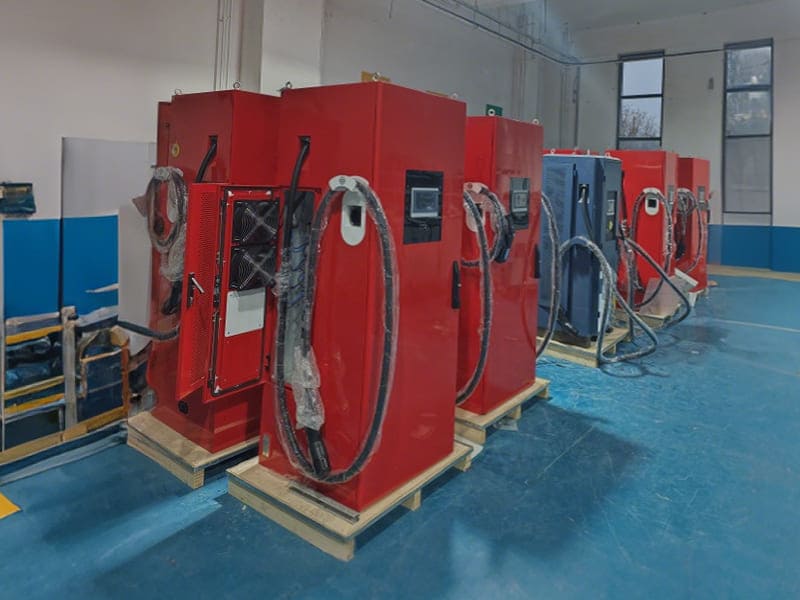
DC Fast Charging: Key Details for EV Charging Station in High-Traffic Areas
Let me focus on DC fast chargers. They are also called quick chargers. The details for EV charging station for highways include multiple plugs. Our 60kW–320kW models have dual, triple, or quadruple outputs. Consequently, one station serves several EVs at once. Split-type chargers separate the power cabinet from the dispensing posts. This design saves space in crowded lots. Moreover, we support CCS2, CCS1, GB/T, CHAdeMO, and NACS. Hence, compatibility is never an issue. For example, a fleet with mixed brands benefits greatly. Installation requires professional electricians. You also need grid agreements for high load.
AC Slow Charging: Practical Details for EV Charging Station at Home
Now consider AC chargers for slower needs. These are perfect for residences and offices. The details for Electric Vehicle charging station for garages focus on convenience. Our 7kW, 11kW, and 22kW units work silently overnight. They use Type1, Type2, GB/T, or NACS plugs. Single-gun or double-gun options provide flexibility. For instance, a double-gun 22kW charger serves two EVs simultaneously. Installation is simpler than DC. A standard wall socket works for 7kW. However, 22kW needs a dedicated circuit. Therefore, hire a certified installer. Many homeowners prefer AC for cost savings. Supply for EV charging station: What are the top 5 brands for commercial use?
My Company’s Offerings: Full Support Based on Real Details for EV Charging Station
Aegen New Energy provides complete solutions. We sell home and commercial EV stations. All our products rely on accurate details for Electric Vehicle charging station. We also offer free technical support. Customization is available for any project. Moreover, we partner with many dealers and installers. Additionally, we supply parts or full systems to assembly companies. Our DC fast chargers (20kW–320kW), AC home/public EV chargers (7kW–22kW), and portable chargers sell well. We ship to Central Asia, the Middle East, Europe, and South America. Customers love our reliability and performance. Finally, we provide free installation advice. Contact us for tailor-made designs.
Conclusion: Master the Details for EV Charging Station Today
To sum up, connector, power, and installation drive your choice. The details for EV charging station decide success. For highways, pick DC with multiple plugs. For homes, choose AC 7kW–22kW. Always verify grid capacity first. I recommend consulting experts. At Aegen New Energy, we share every detail for free. Let us build your perfect station.