
As a leading manufacturer, I at Aegen New Energy explain these core differences. The EV charging station power supply type fundamentally dictates charging speed and infrastructure. This knowledge is vital for both homeowners and commercial operators. Aegen provides complete charging solutions globally. We offer extensive technical support and customization options freely.
Understanding The Basic Power Flow
Simply put, the EV charging station power supply origin is the grid. Both AC and DC EV charging stations initially receive alternating current. However, they handle this current differently. Ultimately, an electric vehicle’s battery requires direct current (DC) for storage. Consequently, the conversion location is the key distinction. This process determines overall efficiency and speed.
How AC EV Charging Works
Firstly, AC stations provide alternating current to the vehicle. Therefore, the vehicle’s internal charger converts AC to DC. This onboard converter is typically small and limited. As a result, charging speeds are generally slower. However, AC systems are simpler and less expensive to install. They are perfect for locations with long dwell times. For instance, homes and workplaces often use AC charging.
Aegen’s commercial AC EV charger range includes 7kW, 11kW, and 22kW models. Moreover, these feature Type 1, Type 2, GB/T, and NACS connectors. They offer single or dual plug options. Consequently, they suit residential complexes and corporate parking lots perfectly. Furthermore, our home chargers are wall-mounted units. They provide reliable overnight charging conveniently.
How DC EV Charging Works
Conversely, DC stations perform the conversion externally. The EV charging station power supply conversion happens inside the charging cabinet itself. This converter is much larger and more powerful. Therefore, it delivers DC power directly to the battery. This bypasses the car’s onboard limitations completely. As a result, charging speeds are dramatically faster. DC stations are essential for long-distance travel.
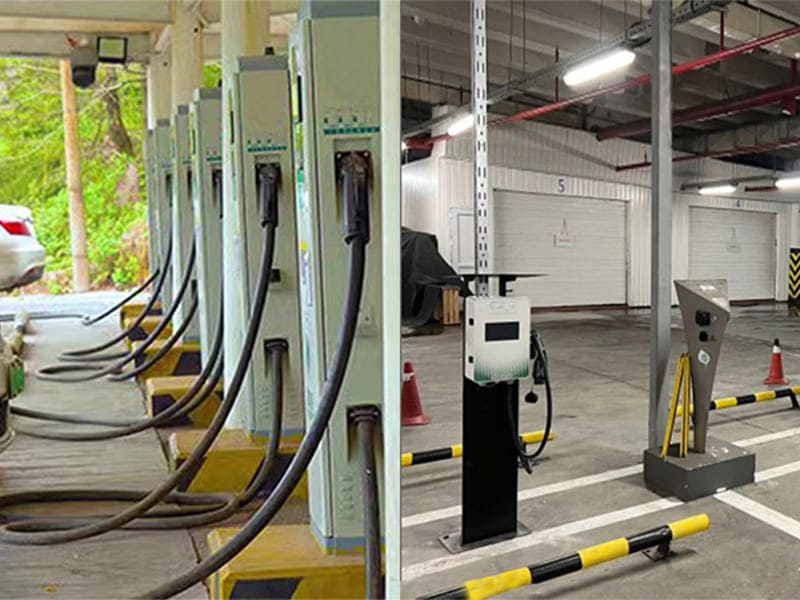
Our DC portfolio serves diverse commercial needs powerfully. For example, we offer robust models from 20kW up to 320kW. Additionally, these support CCS1, CCS2, GB/T, CHAdeMO, and NACS plugs. Consequently, they accommodate almost all vehicle types seamlessly.
Key Differences Summarized
Feature AC Charging Station DC Fast Charging Station
Current Type Supplied Alternating Current (AC) Direct Current (DC)
Conversion Location Inside the Electric Vehicle Inside the Charging Station
Typical Power Output Lower (3.5kW – 22kW) Higher (20kW – 320kW+)
Charging Speed Slower (Hours) Faster (Minutes)
Infrastructure Cost Lower Significantly Higher
Primary Use Case Home, Work, Overnight High-Traffic Commercial, Highways
Choosing The Right EV Charging Station Power Supply
Selecting the correct EV charging station power supply depends on your needs. Consider the required charging speed carefully. Evaluate the available installation budget. Analyze the typical user dwell time. For instance, a fleet depot might prioritize different needs than a retail center. EV Charging Stations UAE 2026: Fast Charging Hubs & New Installations.
Commercial Applications for DC Fast Charging
Our DC solutions fit many high-traffic locations ideally. For example, 60-120kW units serve retail centers effectively. Meanwhile, 120-240kW models are perfect for highway stations. Our split-type systems are ideal for large parking areas. Furthermore, we offer a simple 20/30kW DC model. This provides an affordable and fast option for fleets.
Commercial & Residential Applications for AC Charging
AC charging suits longer parking scenarios perfectly. For instance, our commercial AC stations are ideal for apartment buildings. Similarly, corporate offices benefit from employee charging. Our 7kW/11kW home chargers are also very popular. Additionally, we supply 3.5kW/7kW portable EV chargers. These offer incredible convenience for drivers.
Aegen’s Commitment to Global Solutions
In conclusion, understanding the EV charging station power supply is crucial. AC and DC serve complementary roles in the EV ecosystem. Aegen New Energy manufactures both types reliably. We supply high-quality products across multiple continents. Our teams in Asia, Europe, and the Middle East provide excellent support. We partner with installers and assemblers worldwide. Aegen tailors solutions for home, business, and fleet use. Therefore, we empower the global transition to electric mobility sustainably. Finally, choose Aegen for dependable and innovative charging technology.