
Understanding charger types is crucial for EV owners. Aegen, a leading manufacturer, explains the key differences. Specifically, we compare AC and DC EV charging station Wall units. This guide will help you choose wisely.
The Core Difference: Power Conversion
First, electricity from the grid is always AC. An EV charging station Wall unit must convert it for the car’s battery. AC chargers send power to the vehicle’s onboard converter. The car then changes AC to DC itself. Consequently, this process is slower.
However, DC chargers skip the car’s system. They convert AC to DC inside the charger itself. Therefore, DC EV charging station for home units deliver power directly to the battery. As a result, charging speeds are dramatically faster.
AC EV Charging Station Wall Units: Slow and Steady
Aegen produces various AC Electric Vehicle charging station Wall models. These are ideal for places where cars park for hours. For instance, commercial AC chargers suit garages and residential areas. They are also perfect for public parking lots and corporate campuses.
Typically, these Aegen units feature Type 1, Type 2, GB/T, or NACS plugs. Moreover, they come in single-gun and dual-gun versions. Their power outputs are usually 7kW, 11kW, or 22kW. Because they use the car’s internal charger, AC EV charging station Wall units have a longer charging time. They are cost-effective for overnight use.
Home and Portable AC Solutions
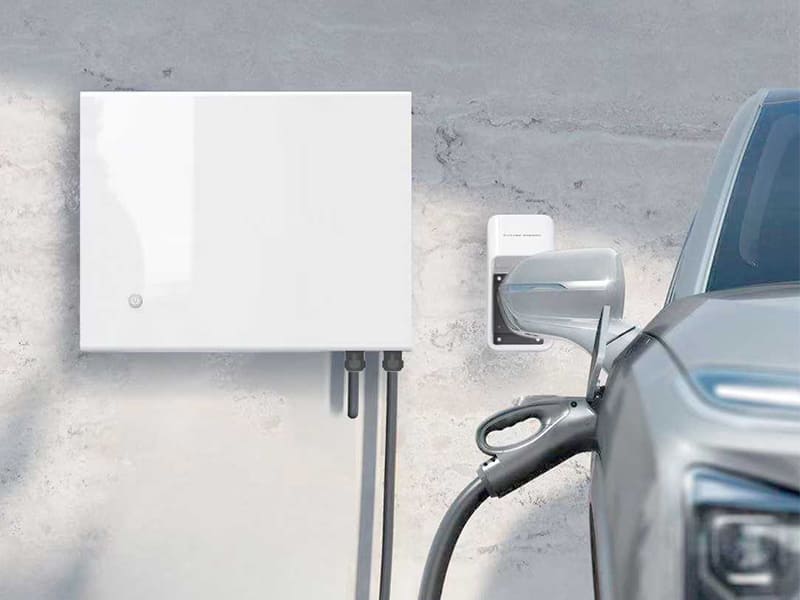
For home use, Aegen offers a 7kW, 11kW, or 22kW AC residential wall unit. This Electric Vehicle charging station Wall box is compact and efficient. It is perfect for daily top-ups.
Additionally, Aegen provides portable EV chargers. These are available in 3.5kW, 7kW, and 11kW versions. Users can carry them in the car easily. This EV charging station Wall alternative offers great flexibility. It ensures power is always accessible.
DC Fast Charging Station Wall Units: Speed and Power
DC Electric Vehicle charging station Wall chargers are built for speed. They are commonly found along highways. Aegen’s DC units bypass the car’s converter. Hence, they can replenish a battery to 80% in under an hour. Some ultra-fast models do it even faster.
These units are larger and more complex. They contain powerful conversion components. Because of this, they are more expensive than AC units. Nevertheless, for quick stops, a DC EV charging station Wall is unbeatable.
Key Specifications Compared
To summarize, here are the main points:
AC EV Chargers: Use Type 1, Type 2, GB/T, or NACS plugs. Power: 7kW to 22kW. Charging: Slow (several hours).
DC Chargers: Often use CCS or CHAdeMO plugs. Power: 20kW and above. Charging: Fast (under 1 hour).
Aegen’s Commitment to Quality
Aegen is a dedicated Electric Vehicle charging station enterprise. We provide complete stations and parts. Importantly, we offer free technical support. We also provide customization services. Don’t Let Your Charger Sit Idle: The Critical Link Between Location and Utilization Rates for EV Charging Stations in Qatar.
Our partners include many EV charger dealers. We also work with assembly firms and installation companies. Consequently, Aegen chargers operate successfully worldwide. They are used across Central Asia, the Middle East, Europe, and South America. As a result, we have earned high customer recognition.
Making Your Choice
Deciding on an EV charging station Wall depends on your need. For overnight home charging, an AC unit is best. For long journeys, a DC EV charging station Wall is essential. Aegen can help you select the right equipment. Contact us to learn more about our innovative solutions.