
The market for an EV charging station in Germany is expanding rapidly, with nearly 200,000 public EV charging stations now available. However, success is not just about installing hardware. It requires a precise, data-driven strategy. Consequently, operators who master site selection can significantly outperform their competitors. In fact, strategic placement can increase profitability by as much as 30%. This article explores how to achieve this through intelligent planning and the right technology.
The Critical Importance of Location
First and foremost, location dictates utilization rates. An EV charging station in Germany placed in a low-traffic area will struggle to generate revenue. Conversely, a station in a high-demand zone becomes a profit center. Therefore, operators must analyze real-world data to identify optimal sites. Research indicates that correlating existing charging data with points of interest reveals untapped potential. As a result, installations near restaurants or shops see much higher usage.
Matching Technology to Traffic Patterns
Selecting the correct hardware is just as vital as picking the spot. For instance, locations with high customer turnover require different solutions than long-duration parking areas.
High-Power DC Solutions for Retail
Retail environments are ideal for fast charging. An EV charging station in Germany located at a supermarket allows customers to charge while they shop. This strategy directly boosts customer loyalty. For such spots, operators need reliable, high-speed equipment.
Commercial DC Fast EV Charger: This category includes versatile 20kW-40kW, 60kW-120kW, and 120kW-240kW units. Many feature dual, triple, or quad connectors. They support various plug types like CCS2, CHAdeMO, and NACS.
High-Traffic HPC Units: For major highways or busy transport hubs, 60kW-320kW systems are essential. Furthermore, large-scale facilities benefit from split-type charging stations with massive 480kW, 720kW, or 960kW output. These ensure that an EV charging station in Germany can serve multiple vehicles quickly without long queues.
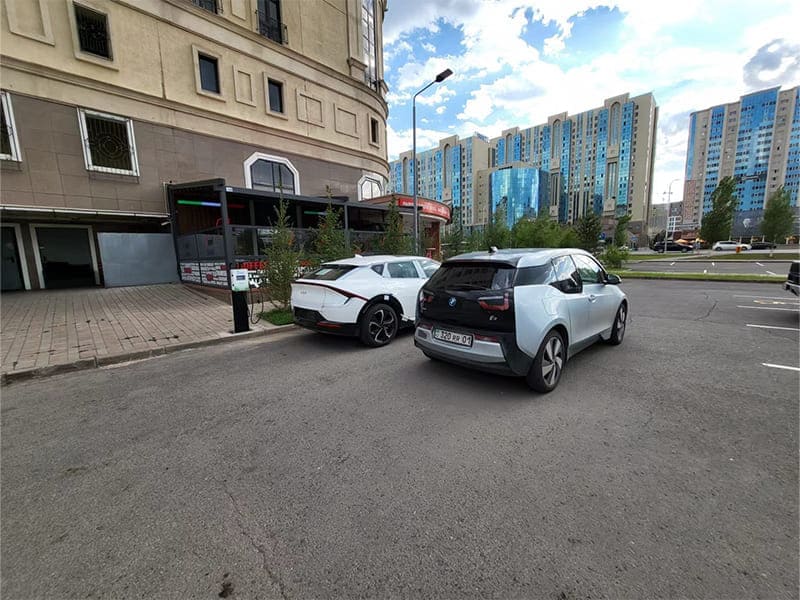
AC Options for Destination Charging
Conversely, locations where vehicles park for hours need cost-effective AC solutions. Workplaces, hotels, and residential areas are perfect for this.
AC Business EV Charger: Typically available in 7kW, 11kW, and 22kW models. They often come with single or dual Type 2 connectors. Consequently, they provide a perfect fit for overnight or full-work-day charging sessions. This ensures that an Electric Vehicle charging station in Germany meets the needs of commuters and residents efficiently.
Operational Models That Minimize Risk
Many businesses hesitate due to the complexity of operation. However, innovative models now eliminate this burden. Instead of owning the hardware, retailers can lease their parking space to energy suppliers . This approach provides a steady income stream without operational headaches. The lessor handles planning, construction, and maintenance. Therefore, the property owner profits while the specialist ensures the EV charging station in Germany runs smoothly.
Moreover, investing in infrastructure is becoming accessible to private capital. Some platforms now allow individuals to purchase charging stations as tangible assets. These are then leased back to operators, generating attractive returns . This influx of private money accelerates the expansion of the network. Ultimately, every new Electric Vehicle charging station in Germany contributes to a denser, more reliable grid. EV Charging Station in NYC: Are You Leaving Money on the Table? The Answer Lies in Your Parking Lot’s Location.
Leveraging Expertise and Technology
To maximize margins, operators must also consider future-proofing their investments. Integrating charging stations with photovoltaic systems and battery storage can drastically reduce energy costs . Furthermore, battery-buffered chargers allow for ultra-fast installation even where grid capacity is limited . This innovation means an EV charging station in Germany can be deployed at virtually any retail site.
Manufacturers play a key role in this ecosystem. For example, AEGEN is a dedicated manufacturer of complete charging stations and components. They provide free technical support and customization services. Their product range covers everything from residential units to large-scale commercial hubs. Additionally, they supply EV charging testers to installation and assembly companies. With installations across Central Asia, the Middle East, Europe, and South America, their experience ensures reliability. Choosing a trusted partner is crucial when deploying an EV charging station in Germany.