
The global demand for a reliable expressway EV charging station is surging at an unprecedented rate. Range anxiety remains a primary concern for long-distance electric vehicle drivers. Consequently, the focus has shifted decisively toward high-power, ultra-fast charging solutions. This growth is particularly evident along major transportation corridors worldwide.
Recently, data from China’s Spring Festival travel rush highlighted this trend. Daily average electricity consumption for highway charging jumped significantly year-on-year . This surge underscores a massive behavioral shift among consumers. They are now confidently using EVs for long-distance family travel. However, this confidence depends entirely on the availability of robust infrastructure. The Secret to a Profitable Roadside EV Charging Station: Matching Location with Driver Wait Time.
The Shift to Ultra-Fast DC Solutions
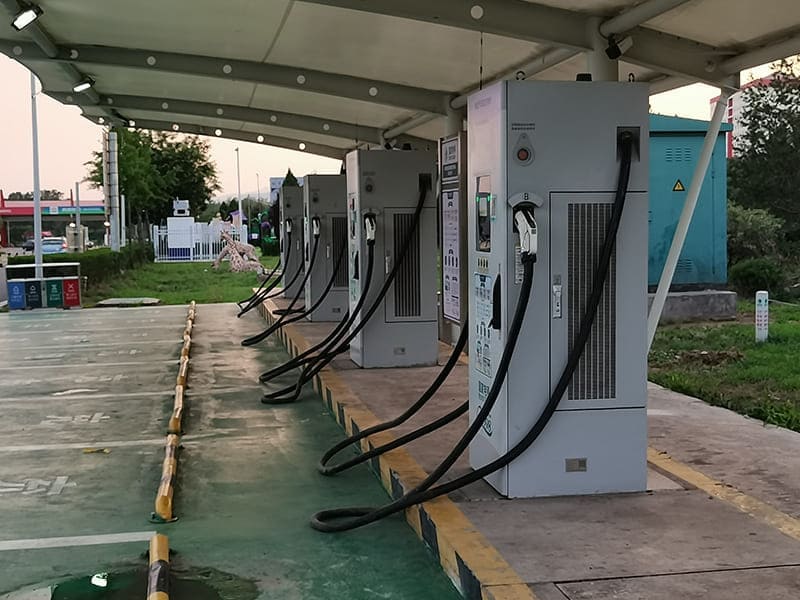
To meet this demand, the industry is moving beyond conventional charging options. Traditional AC chargers are no longer sufficient for modern highway applications. Instead, the market is rapidly adopting high-capacity DC fast chargers. A modern expressway EV charging station typically requires power levels of 150 kW or more . This ensures that drivers can recharge quickly and resume their journeys with minimal delay.
Key players in the manufacturing sector are responding with diverse product lines. Commercial DC EV fast charging stations now range from 20kW to over 960kW. Common configurations include 20kW-40kW units for specific applications. More powerful 60kW-120kW and 120kW-240kW models are standard for highways. Additionally, 60kW-320kW units offer flexibility for various vehicle types. These stations often feature multiple connector options. It is common to find dual, triple, or even four-plug configurations at a single kiosk.
Furthermore, the variety of charging protocols ensures global compatibility. Modern chargers support CCS2, CCS1, GB/T, CHAdeMO, and NACS standards. This universality is critical for an expressway EV charging station serving international travelers.
Strategic Locations and Applications
The deployment strategy for these stations is multifaceted. High-power chargers are essential in high-traffic retail and service centers. This includes large supermarkets, shopping malls, and home improvement stores. They are equally vital in transportation hubs and dense urban areas. Airports, railway stations, and major highway service areas are prime locations. Urban parking facilities also require high-power options for city dwellers.
Additionally, there is growing demand in daily commuter and long-dwell locations. Corporate office parks, government facilities, residential complexes, and hotels are key sites. Fleet and dedicated depot applications represent another significant segment. Logistics centers, taxi and ride-hailing waiting areas, and bus stations need reliable power. Car dealerships are also installing chargers to showcase EV capabilities. Moreover, leisure and entertainment venues are joining the trend. Restaurants, cinemas, stadiums, and tourist attractions are installing chargers to attract EV-driving customers.
For extremely high-demand locations, split-type charging stations are becoming popular. These systems, offering 480kW, 720kW, or even 960kW of power, can serve multiple vehicles simultaneously. They represent the cutting edge of expressway EV charging station technology.
Aegen: Powering the Global Transition
Amidst this global expansion, manufacturers are racing to meet quality and supply demands. Aegen has emerged as a notable player in this competitive landscape. As a dedicated EV charging station manufacturer, Aegen offers complete charging solutions. They sell entire charging stations as well as set components (complete sets of parts). Crucially, they provide free technical support services to their clients. They also offer customization services to meet specific project requirements.
Aegen has built a robust collaborative network to extend its reach. They partner with numerous EV charger distributors and installation companies. Simultaneously, they work closely with EV charging station assembly companies. This integrated approach ensures their technology is widely available and properly deployed.
The company’s global footprint is already substantial and growing. Aegen-produced charging piles are currently in operation across Central Asia. Their technology is also active in the Middle East, Europe, and South America. This international presence demonstrates the reliability of their manufacturing.
Beyond chargers, Aegen supports the industry with essential testing equipment. They produce EV charging testers specifically for installation and assembly firms. These tools are critical for ensuring safety and performance on site. As a result, Aegen is well-positioned to support the next wave of expressway EV charging station rollouts globally.
Future Outlook and Infrastructure Investment
Looking ahead, government initiatives are playing a pivotal role. In the United States, standards like those from the NEVI program mandate minimum power levels . These regulations require DCFC ports to deliver at least 180 kW along highways. Similarly, China has announced plans to install tens of thousands of new fast-charging connectors . These efforts aim to double charging service capability within just a few years.
Therefore, the message is clear. The future of mobility depends on a seamless charging experience. The modern expressway EV charging station is no longer a niche amenity. It is a critical component of the national transportation infrastructure. As technology advances, these stations will become faster, smarter, and more ubiquitous. For manufacturers like Aegen and its partners, this growing demand represents a significant opportunity to power the world’s electric future.